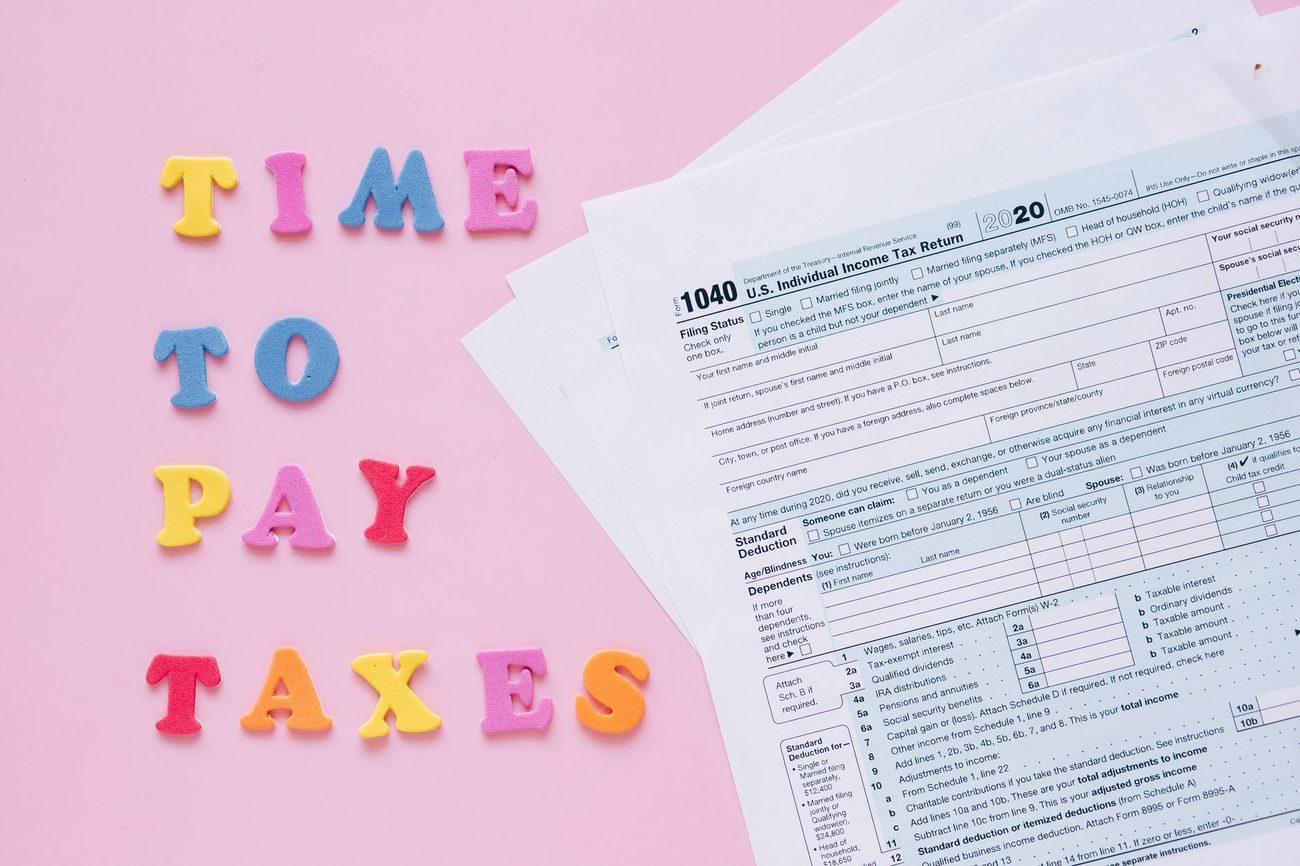
Our tax preparer works out of an office above a storefront downtown, and on Tuesday evening Tyler carried a gallon zipper bag of mowing receipts up her stairs like he was delivering evidence. She took it, set it on the desk next to a candy dish, and pulled out a form with "Schedule C" across the top.
That was our first year filing with side income. I'm a pharmacy tech, not a tax person, so please take this as one couple's story and not advice. Your situation could be different in a dozen ways, and someone who does this for a living can tell you which ones.
Here's where we started. Tyler began mowing in May, had six yards at $35 a week by June, and kept it up through September. He mowed 96 times and brought in $3,360. From the very first payment, 25% of every dollar went into a separate savings bucket we call the tax bucket. By fall that was $840.
The reason for the 25% was simple. Nobody withholds anything from mowing money. On top of regular income tax, self-employment income owes self-employment tax, which is Social Security and Medicare for people who work for themselves. On a paycheck, the employer pays half of that. When you're the employer, you pay both halves.
What we tracked
- Every payment: the date, the customer and the amount, entered in the sheet the night it came in.
- Expenses, with receipts in that zipper bag: the $180 mower, about $150 in gas for the mower and trimmer, and $60 in blades, trimmer line, oil and a spark plug. That's $390.
- Miles driven between yards, in a little notebook in the truck door: 280 miles. At the 2025 IRS standard rate of 70 cents a mile, that's $196.
Tyler didn't start the mileage notebook until the middle of June, so we probably left a few May miles on the table. That's the first thing we'd do differently.
What filing looked like
The mowing went on a Schedule C, the form for profit or loss from a business, even a business that's one man and a push mower. $3,360 coming in, minus $390 in expenses and $196 for mileage, left $2,774 of profit.
Self-employment tax is 15.3%, figured on about 92% of the profit, and it applies once that profit reaches $400 for the year. On $2,774 it came to about $392. Then the profit gets added to our regular income for federal and Missouri income tax, which our preparer figured at about $370 more. All in, the mowing cost us about $760 in tax.
We'd set aside $840. So the 25% covered it with $80 to spare, which is the direction you want to be wrong in.
Two things surprised us. First, there was no bill. Both of our paychecks have taxes withheld all year, and we usually get a refund. The side income just made the refund smaller. Our refund this year is $2,540. Our preparer said that without the side income it would have been about $3,490.
Second, my furniture flips counted too. I started in October and made $596 of profit by the end of December. Add $120 of odds and ends, from Tyler hanging Christmas lights for two of his mowing customers and fixing a neighbor's leaf blower, and that was about $190 more in tax. I hadn't set aside a penny for any of it. So all our side money together cost about $950 in tax, and the bucket was about $110 short.
Since the tax came out of our refund instead of a separate bill, we moved the $840 from the tax bucket to the house fund, which is where the refund is going anyway. The money took the long way around, but it got there. I also asked about the $318 I made selling closet clutter in December. Because we sold our own things for less than we paid, our preparer said that isn't income.
What we're changing for 2026
Starting this month, 25% of all our side money goes to the tax bucket, not just the mowing. Flips, odds and ends, all of it. Tyler is planning on more yards this summer, so the mileage notebook lives in the truck now and starts with the first mow. And our preparer said that if the mowing grows a lot, we should check partway through the year whether we need to pay quarterly estimated taxes or have more taken out of Tyler's paycheck. I wrote that on the fridge calendar for June.
Paying her was new for us, too. We used to do our own return with tax software. This year we paid $175, because I didn't trust myself with a Schedule C the first time around. Next year we might try it ourselves again with this year's return as a guide. This year I just wanted to watch somebody do it right once.